The 3 Habits That Help Me Reset: Breathing, Meditation, and Journaling
Simple Self-Care Habits for Teen Mental Health
I know what it feels like to think there is no time for self-care. Between school, practice, homework, friendships, and everything else competing for your attention, adding one more thing to your day can feel impossible.
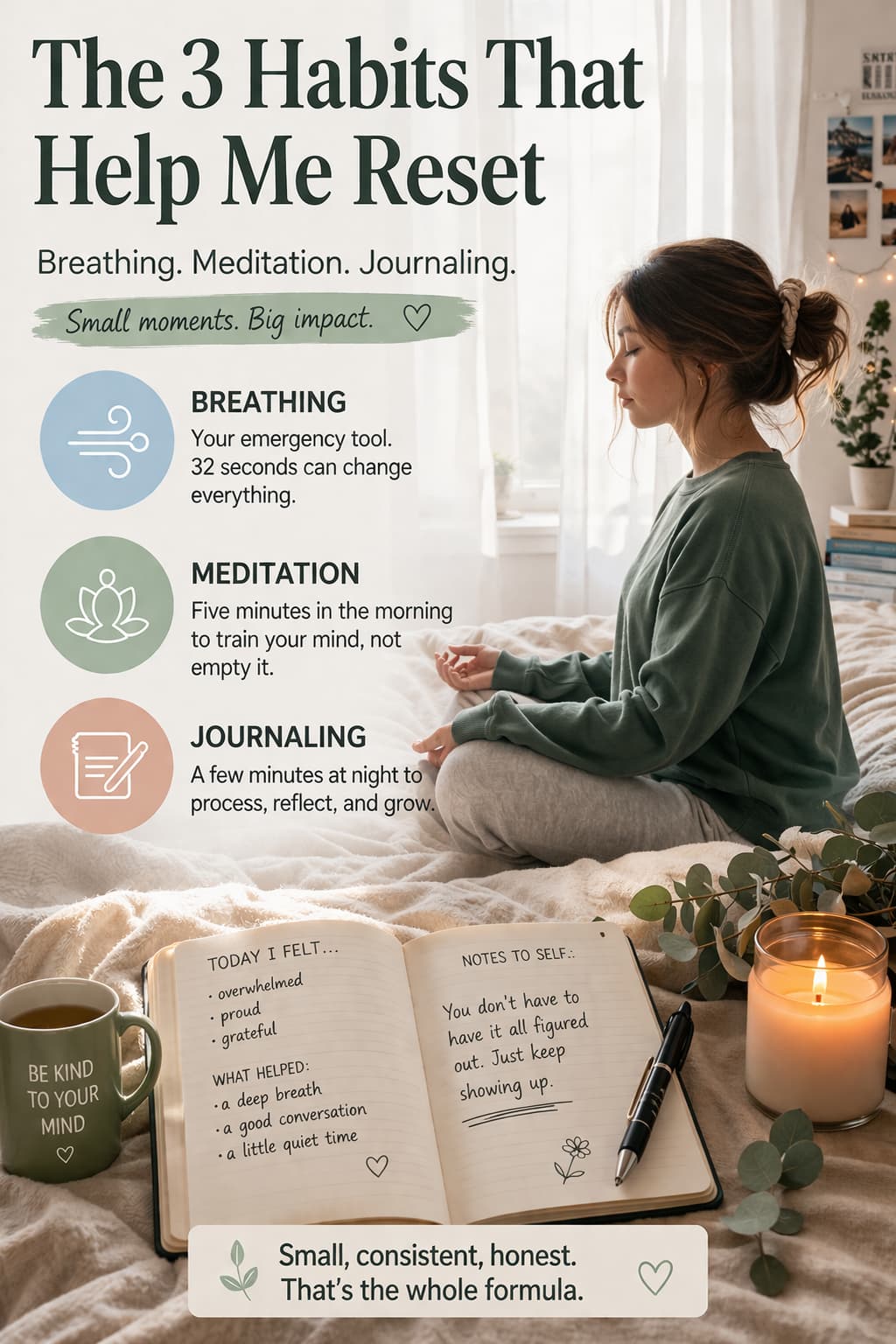
That is exactly why the habits I rely on most are simple: breathing, meditation, and journaling.
They do not require a perfect routine, a huge time commitment, or a complete lifestyle reset. They just ask you to show up for yourself in small, honest moments. And honestly, those small moments can make a bigger difference than people realize.
Why Small Daily Habits Matter for Mental Wellbeing
When life feels overwhelming, it is easy to assume that feeling better requires some major change. But most of the time, it does not.
What has helped me the most has not been doing everything perfectly. It has been having a few realistic tools I can come back to when I feel stressed, anxious, overstimulated, or emotionally drained.
That is what these three habits have become for me. They help me reset when my mind feels too full, when I feel disconnected from myself, or when I just need a second to breathe and come back to center.
They are simple, but they are powerful.
Breathing: The Fastest Way to Calm Down in the Moment
If you do not know where to start, breathing is probably the easiest and most effective place.
I think of it as an emergency tool, something you can use right in the middle of real life. Maybe it is before a test, after an awkward conversation, during a stressful practice, or in one of those moments when your chest feels tight and your thoughts start moving too fast.
When that happens, even a short breathing exercise can help bring you back.
One method I come back to often is box breathing:
- Inhale for 4 counts
- Hold for 4 counts
- Exhale for 4 counts
- Hold for 4 counts
Even doing that twice only takes about 30 seconds, but it can completely shift how your body feels. It works because it helps slow your nervous system down and creates a small pause between what is happening and how you respond to it.
And sometimes, that pause is everything.
Meditation: Learning How to Slow Down Your Mind
Meditation works differently than breathing, but it has been just as helpful for me.
I think the best time to do it is in the morning, even if it is only for five minutes before checking your phone. Before the noise of the day starts, before your brain gets pulled in ten different directions, there is something really grounding about sitting still for a few minutes and just being with yourself.
It does not have to be complicated.
Sit somewhere quiet, close your eyes, and focus on your breath. When thoughts come in, and they will, just notice them and gently come back.
That is the whole practice.
A lot of people think meditation means clearing your mind completely, but that is not really the goal. You are not trying to stop thinking. You are learning how not to get carried away by every thought that shows up.
Over time, that skill starts to show up in everyday life too. You become less reactive. You catch yourself before spiraling. You learn how to stay more present instead of feeling pulled in every direction all at once.
Journaling: A Healthy Way to Process Stress and Emotions
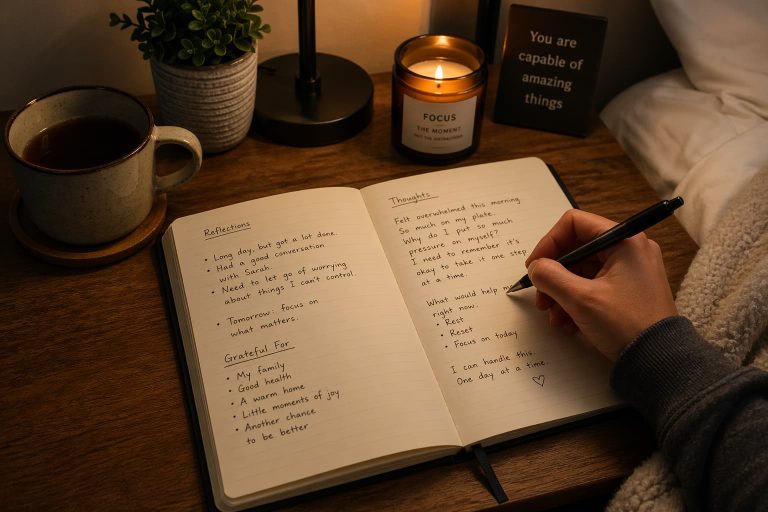
Journaling is what helps me process everything at the end of the day.
I like doing it at night, even if it is only for five minutes. It does not need to be deep or perfectly written. You do not need prompts, a beautiful notebook, or the right words. You just need honesty.
Write down what happened that day. Write how you felt about it. Write what is sitting heavy in your mind.
That simple habit creates distance between you and your thoughts. Instead of replaying conversations in your head while trying to fall asleep, you have already given those thoughts somewhere to go.
That is what makes journaling so helpful. It lets you process emotions instead of storing them.
And over time, it becomes more than just a place to vent. It becomes a record of your growth. You start noticing patterns. You see what drains you, what helps you, what keeps showing up, and what you spend so much energy worrying about that never actually happens.
That kind of self-awareness is powerful.
Why These Self-Care Habits Actually Work
What I like most about breathing, meditation, and journaling is that they are realistic.
They are not about becoming a completely different person overnight. They are not about having your life perfectly together. They are about checking in with yourself consistently enough that you stop ignoring what you need.
And I think that is what real self-care actually looks like.
Not perfection. Not performance. Just paying attention.
These habits work because they help you create space. Space to calm down. Space to think clearly. Space to feel what you are feeling without getting completely swallowed by it.
And when you are a teenager trying to manage school, relationships, pressure, and everything else life throws at you, that kind of space matters.
You Do Not Have to Do It Perfectly to Benefit From It
One of the biggest things I have learned is that these habits do not need to be done perfectly to still help.
Some days you will skip. Some days you will forget. Some days you will sit down to meditate and feel distracted the entire time. Some days journaling will feel awkward or pointless. That does not mean it is not working.
The goal is not to build a perfect streak.
The goal is to build trust with yourself.
It is learning that even after a hard day, a busy week, or a stressful season, you can always come back to yourself again.
That is what matters most.
How to Start a Simple Self-Care Routine as a Teen
If you are not sure where to begin, start with breathing.
It takes the least amount of time, and you can use it almost anywhere. Once that feels natural, try adding a few minutes of meditation in the morning or journaling at night.
You do not need to start all three at once. You do not need to make it perfect. Just start small and stay honest with yourself.
That is really the whole formula:
Small. Consistent. Honest.
And sometimes, that is more than enough.